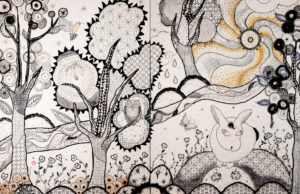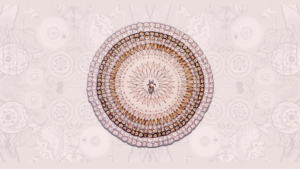
このエッセイシリーズで取り上げる自然界の構造やリズムは、私の作品に一貫して流れている着想の源でもあります。
雪の結晶、葉脈、銀河、そしてさまざまな自然現象を観察することは、作品の形を探すためというよりも、その背後にある秩序や関係性を理解するための試みです。
ここで取り上げるテーマは、自然を観察する視点であると同時に、私自身の制作を支える思考の土台でもあります。
The structures and rhythms of nature explored here are also among the primary sources of inspiration behind my work.
Observing snowflakes, leaf veins, galaxies, and other natural phenomena is not simply a search for visual forms, but an exploration of the underlying order and relationships that give rise to them.
The themes presented here are therefore not only ways of observing nature, but also part of the conceptual foundation that informs my artistic practice.
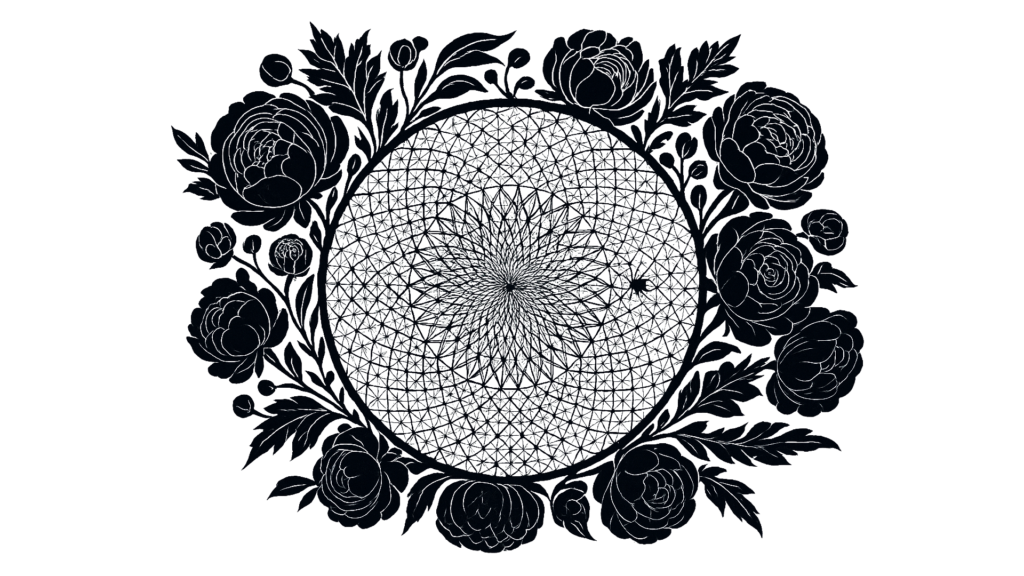
雪の結晶 ─ 六角形の秩序
冬の空から舞い降りる雪の結晶。そのひとひらを顕微鏡でのぞくと、必ず六角形を基盤とした文様が現れます。枝の長さも角度も見事に揃い、まるで誰かが設計図を引いたかのような精緻さ。自然が描くこのかたちは、偶然ではなく「秩序の必然」です。結晶は水分子が氷になるとき、分子同士が六方向に結びつく性質を持つことから生まれます。分子レベルの規則性が、そのまま結晶全体にまで拡大し、雪片という「ミクロとマクロの一致」を生み出しているのです。
フラクタル的に見ると、雪の結晶は「同じパターンの繰り返し」が多層的に展開される象徴でもあります。中心から広がる枝は自己相似のリズムを奏で、無限に続くかのような連なりを私たちに感じさせます。その姿は、宇宙の銀河や樹木の枝葉にまでつながる「自然のコード」の一端です。
六角形はまた、数学的に最も効率的なかたちのひとつ。平面を隙間なく埋め、最大の安定性を保ちながらエネルギーを最小限に抑える──蜂の巣や鉱物結晶も同じ原理で六角形を選び取ります。雪の結晶が一瞬の美しさを宿すのに対し、蜂の巣は持続のための秩序を宿す。そこに「儚さと永続」の二つの顔を、六角形は映し出しています。
雪の結晶を手のひらに受けるとき、私たちはその形をすぐに失ってしまいます。しかし、その一瞬に凝縮された六角形の秩序は、宇宙の深い法則とつながっています。自然が描くフラクタルは、目に見えぬ秩序をそっと教えてくれるのです。
象徴としての雪の結晶
それは、目に見える世界と見えない世界をつなぐ“橋”のような存在です。形の中に潜む秩序の記憶であり、永遠に変わらない宇宙のリズムを静かに映し出しています。
葉脈 ─ 樹形にひろがるフラクタル
一枚の葉を手に取り、光にかざすと、無数の細かな筋が網のように走っているのが見えます。これが葉脈。太い幹から細い枝が広がる樹形と同じように、葉脈もまた中心から分岐し、末端へと広がるフラクタルな構造を示しています。
効率と秩序のかたち
葉脈は、根から吸い上げた水や養分を葉全体に行き渡らせるための通路です。その構造は極めて合理的で、無駄なく、効率的に全体へと資源を分配します。大きな主脈から側脈が分かれ、さらに細かな網目へと展開していくリズムは、まるで生命を流れる血管のよう。自然が導き出した最適解がそこにあります。
自己相似性 ─ 小さな枝と大きな枝
葉脈の広がりをよく見ると、太い脈と細い脈は異なるようでいて、どちらも同じパターンに基づいています。これは「自己相似性」と呼ばれるフラクタルの特徴です。一本の樹木が大地から空へと枝を伸ばす姿と、一枚の葉の中に走る葉脈とは、スケールこそ違えど、同じ原理によって形づくられているのです。
象徴としての葉脈
古来、葉は「生命」「再生」「成長」のシンボルとされてきました。その内部に刻まれた葉脈は、目には見えない「生命のネットワーク」の可視化とも言えます。葉脈の分岐は、宇宙に張り巡らされたエネルギーの流れを思わせ、私たち自身の血流や神経網とも重なります。そこに「自然と人間」「微視と巨視」が共鳴する世界観が浮かび上がります。
自然のリズムを映す
葉脈を観察すると、ただの植物の一部ではなく、自然全体に通じる秩序が見えてきます。大地の水を受け取り、空の光を浴び、その間をつなぐかたちとして現れるフラクタル。葉脈は、生命そのものが持つ「広がりと循環」のリズムを、静かに教えてくれているのです。
銀河 ─ 螺旋の宇宙
夜空を見上げると、無数の星々が帯のように広がり、その奥に果てしない渦の構造が隠されています。私たちが暮らす天の川銀河も、その全体像は巨大な「螺旋」を描いていると考えられています。その姿は、地上の小さな形態──渦巻く貝殻やひまわりの花序──と呼応し、宇宙規模のフラクタルを示しているのです。螺旋が生まれる力学
銀河を構成する星々は、中心の重力に引き寄せられながらも、自らの運動エネルギーによって外へ広がろうとします。この二つの力が拮抗したとき、最も安定する形が螺旋です。中心から外へ、規則正しく弧を描きながら広がる銀河の腕は、力学と秩序の結果として自然に生み出されるパターンなのです。
自然と生命に響き合う螺旋
螺旋は銀河に限らず、地球上のあらゆる生命や現象に現れます。貝殻の巻き、シダの葉の展開、台風の渦──その背後にあるのは「成長と展開のリズム」。スケールの差を超えて繰り返されるこの形は、生命の営みと宇宙の秩序が同じ法則に従っていることを私たちに語りかけているようです。
象徴としての螺旋
古代より螺旋は「生成と循環」「進化と永遠」を象徴する形とされてきました。中心へ吸い込む力と外へ解き放つ力を同時に宿し、内と外、始まりと終わりを結び合わせる。銀河の螺旋は、その象徴を最大のスケールで体現する存在だといえるでしょう。
フラクタルとしての宇宙
私たちの血管や神経網に流れる微細な螺旋、植物の茎に沿って配置される葉のらせん、そして星々が渦を巻く銀河。そのすべては異なる次元で繰り返される同じ秩序の表れです。夜空に浮かぶ銀河を見つめるとき、私たちは宇宙の果ての構造に触れると同時に、自らの内側にも響くフラクタルのリズムを感じ取っているのです。
創作と自然のリズム
雪の結晶に刻まれた六角形の秩序。葉脈に広がる分岐のリズム。銀河が描く壮大な螺旋。これらのかたちは一見まったく別のものに見えますが、根底には「フラクタル」という共通の響きが流れています。小さなかたちと大きなかたちが呼応しあい、自然はその奥に潜む秩序をさまざまなスケールで表現しているのです。創作に息づく自然のリズム
糸を重ね、布に針を通す。墨を滲ませ、紙に線を引く。人間の手仕事にもまた、繰り返しと分岐のリズムが存在します。無意識のうちに手が描く模様は、自然界のパターンと重なり合い、やがてひとつの秩序を形づくる。まるで自然の記憶が、私たちの手を通して再びこの世界に刻まれていくかのようです。
見えないものを結ぶ
フラクタルのかたちは、可視と不可視の境界をつなぐ橋でもあります。雪の結晶の儚さは、見えない分子の結びつきを映し出し、葉脈の網は、目に見えぬ生命の流れを示す。銀河の渦は、遠く離れた星々をひとつの秩序に結び合わせています。
「結び」とは単に形を留めることではなく、異なるもの同士を響き合わせる行為なのです。自然と人間の共鳴
手仕事に宿るリズムは、自然の秩序と決して切り離されたものではありません。むしろ、私たちが無心で繰り返す作業の中にこそ、自然界の根源的なパターンが映し出されます。人間の創作は自然から離れた営みではなく、そのリズムを新たな形で翻訳する試みだと思うのです。
これからの予兆
雪、葉、銀河──それぞれ異なるスケールに存在しながら、共通する秩序のもとで響き合っています。自然のかたちは、一見すると多様でありながら、その奥には繰り返し現れる構造やリズムが息づいています。
そうしたつながりを見つめていくことは、自然をより深く理解するだけでなく、私たちのものの見方にも、新たな視点を与えてくれるのかもしれません。
English
Snowflakes — The Order of the Hexagon
Snowflakes descend quietly from the winter sky. When viewed under a microscope, every crystal reveals a pattern founded on a hexagonal structure. The lengths of its branches and the angles between them display remarkable precision, as though drawn from an invisible blueprint. This geometry is not a matter of chance, but an expression of an inherent order within nature.
Snow crystals form as water molecules freeze and bond in six directions. The regularity established at the molecular level extends outward through the entire crystal, creating a remarkable continuity between the microscopic and the macroscopic.
From a fractal perspective, the snowflake exemplifies the repetition of a single structural pattern across multiple scales. Its branches unfold rhythmically from the center, revealing a self-similar organization that suggests an endless process of growth. In this sense, the snowflake reflects the same underlying order found in the spiraling forms of galaxies and the branching structures of trees—a quiet manifestation of nature’s hidden code.
The hexagon is also one of the most efficient geometric forms found in nature. It fills a plane without gaps, providing maximum stability while minimizing the expenditure of energy. Honeycombs and many mineral crystals follow the same geometric principle. While the snowflake embodies a fleeting moment of beauty, the honeycomb represents an enduring order that supports life. Together, they reveal two complementary aspects of the hexagon: transience and permanence.
When a snowflake lands on the palm of a hand, its form quickly disappears. Yet within that brief moment resides the enduring order of the hexagon, connected to principles that extend far beyond the visible world. Through forms such as these, nature’s fractal structures quietly reveal the invisible order that underlies existence.
The Snowflake as a Symbol
The snowflake can be understood as a bridge between the visible and the invisible.
It is a quiet reminder that every form carries within it the memory of an underlying order—a reflection of the enduring rhythms that shape the universe.
Leaf Veins — Fractals Unfolding Through Branching Forms
Hold a leaf up to the light, and a delicate network of veins becomes visible, spreading across its surface like an intricate web. These veins echo the branching structure of a tree itself. Just as a trunk divides into branches and twigs, the veins radiate outward from a central axis, revealing a fractal pattern that extends toward the leaf’s outermost edges.
The Form of Efficiency and Order
Leaf veins serve as pathways, distributing water and nutrients absorbed by the roots throughout the entire leaf. Their organization is remarkably efficient, allowing resources to flow with minimal waste. From the primary vein, secondary veins branch outward, unfolding into an increasingly intricate network. This rhythm of branching resembles the circulatory system of living organisms, reflecting an elegant solution refined through nature’s continual processes.
Self-Similarity — The Same Pattern Across Scales
A closer look at a leaf reveals that its larger veins and finer veins differ only in scale, while sharing the same underlying pattern. This characteristic is known as self-similarity, one of the defining properties of fractal geometry.
The branching form of a tree reaching from the earth toward the sky and the network of veins within a single leaf are expressions of the same organizing principle. Though vastly different in scale, both emerge from a shared structural logic.
The Leaf Vein as a Symbol
Throughout history, leaves have symbolized life, renewal, and growth. The veins woven within them may also be understood as a visible expression of an otherwise invisible network of life.
Their branching patterns evoke the flow of energy throughout nature, while also recalling the circulation of blood vessels and the complexity of neural networks within the human body. In this way, leaf veins suggest a quiet resonance between nature and humanity, between the microscopic and the macroscopic.
Reflecting the Rhythms of Nature
To observe the veins of a leaf is to discover more than a botanical structure. It is to encounter an underlying order that extends throughout the natural world.
Receiving water from the earth and light from the sky, the leaf becomes a place where these forces converge, expressed through a fractal geometry of branching and connection.
Within its delicate network, the rhythms of expansion and circulation that sustain life quietly reveal themselves.
Galaxies — The Spiral of the Cosmos
When we look up at the night sky, countless stars stretch across the heavens like a luminous river. Beyond this familiar view lies a vast spiral structure. Our own Milky Way is understood to be a giant spiral galaxy, its immense form unfolding across the cosmos. This pattern echoes smaller forms found on Earth—the spiral of a seashell or the arrangement of sunflower seeds—revealing a geometry that appears across remarkably different scales.
The Dynamics of the Spiral
The stars that compose a galaxy are drawn inward by gravity while simultaneously moving through space with their own momentum. The balance between these opposing tendencies gives rise to the spiral form. Sweeping outward from the galactic center in graceful arcs, the spiral arms emerge as a natural expression of dynamic equilibrium, shaped by the interaction of motion and gravitational forces.
Spirals Throughout Nature and Life
The spiral is not unique to galaxies. It appears throughout the natural world—in the coiling of seashells, the unfurling of fern fronds, and the swirling structure of hurricanes. Behind these diverse forms lies a common rhythm of growth and expansion.
Although these phenomena differ greatly in scale, they reveal a recurring organizational principle, suggesting that the patterns shaping living organisms and those governing the cosmos are deeply interconnected.
The Spiral as a Symbol
Across many cultures, the spiral has long symbolized generation and circulation, evolution and continuity. It embodies both the movement toward a center and the movement outward, quietly connecting beginnings and endings, interior and exterior.
The spiral galaxy may be understood as one of the grandest expressions of this enduring symbol.
The Universe as Fractal
Spiral patterns appear within the finest structures of life as well as across the vastness of the universe. They can be observed in the organization of plants, in the branching forms that sustain living systems, and in the immense spiral arms of galaxies.
Though these forms exist on vastly different scales, they reveal a shared structural rhythm that recurs throughout nature.
When we contemplate the spiral of a galaxy, we encounter not only the architecture of the distant universe, but also a pattern that quietly resonates within ourselves—a fractal rhythm connecting the microscopic and the cosmic.
Art and the Rhythms of Nature
The hexagonal order inscribed within a snowflake. The branching rhythms woven through the veins of a leaf. The vast spiral traced by a galaxy.
At first glance, these forms appear entirely different. Yet beneath them flows a shared principle: the rhythm of fractal organization. Small forms and large forms echo one another, revealing how nature expresses an underlying order across many different scales.
Nature’s Rhythms in Art
Layering threads, guiding a needle through fabric, allowing sumi ink to spread across paper, drawing a single line by hand—these gestures also embody rhythms of repetition and branching.
Patterns that emerge through the movement of the hand often resonate with those found throughout the natural world. Gradually, repetition gives rise to order, as if nature’s memory were quietly finding expression once again through human hands.
Connecting the Visible and the Invisible
Fractal forms may also be understood as bridges between the visible and the invisible.
The fleeting beauty of a snowflake reflects the hidden organization of water molecules. The network of leaf veins reveals the unseen flow of life. The spiral of a galaxy connects countless distant stars within a single coherent structure.
To connect is not merely to bind forms together, but to allow seemingly separate things to resonate with one another.
Resonance Between Nature and Humanity
The rhythms embodied in art are not separate from the order of nature. Rather, the quiet process of creation often reflects patterns that have long existed within the natural world.
Artistic practice is not an activity apart from nature, but a way of exploring and expressing its underlying rhythms and structures through human perception and creativity.
A Glimpse of What Lies Ahead
Snowflakes, leaves, and galaxies exist on vastly different scales, yet they resonate through shared patterns of order.
Although the forms of nature appear endlessly diverse, recurring structures and rhythms quietly emerge beneath their differences.
To observe these connections is not only to deepen our understanding of the natural world, but also to discover new ways of seeing it.
Related Links|関連ページ
→ Geometric Embroidery + Sumi Ink Art Archive|幾何学刺繍+墨アートの作品アーカイブを見る
→ Nihonga Archive|日本画の作品アーカイブを見る
→ Instagram|Instagramで最新の活動を見る
→ View the Portfolio | Portfolioを見る