自然界に広がる無限のパターン
── かたちのリズムを、針と墨でなぞる
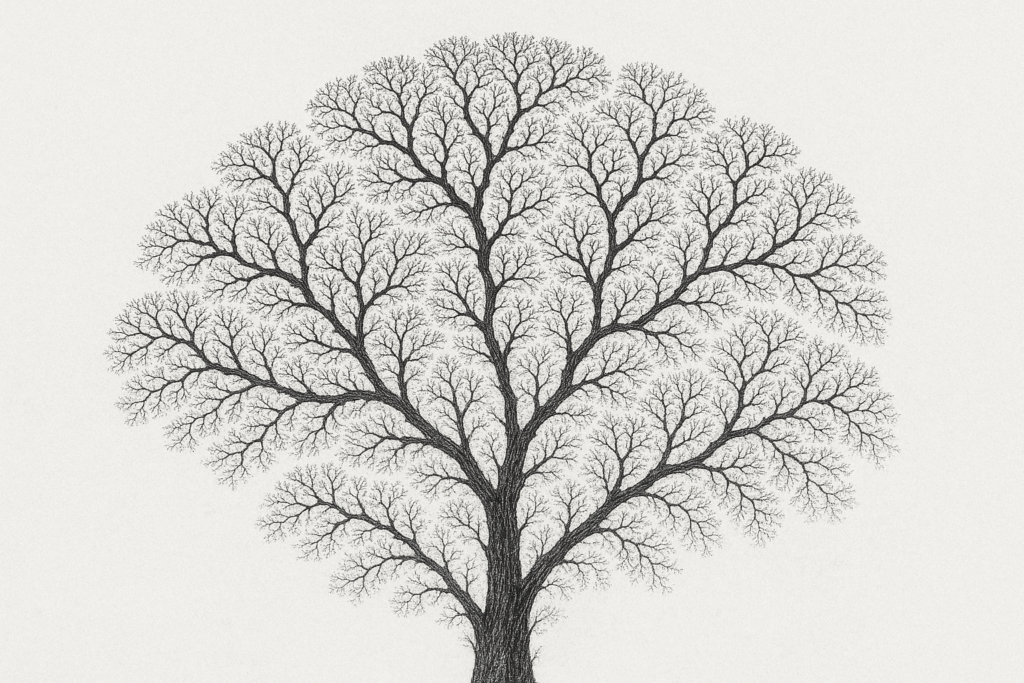
樹木の枝分かれ、川の流れ、海岸線の曲線、雪の結晶──。
ふと足元や空を見上げるだけで、自然の中には「似たかたちが繰り返し現れる」不思議なパターンが数多く存在しています。部分を切り取っても、全体と同じリズムが息づいている。
小さなかたちの中に、大きなかたちが映り込む。
それが“フラクタル”と呼ばれる構造です。この繰り返しのリズムは、私の制作とも深くつながっています。
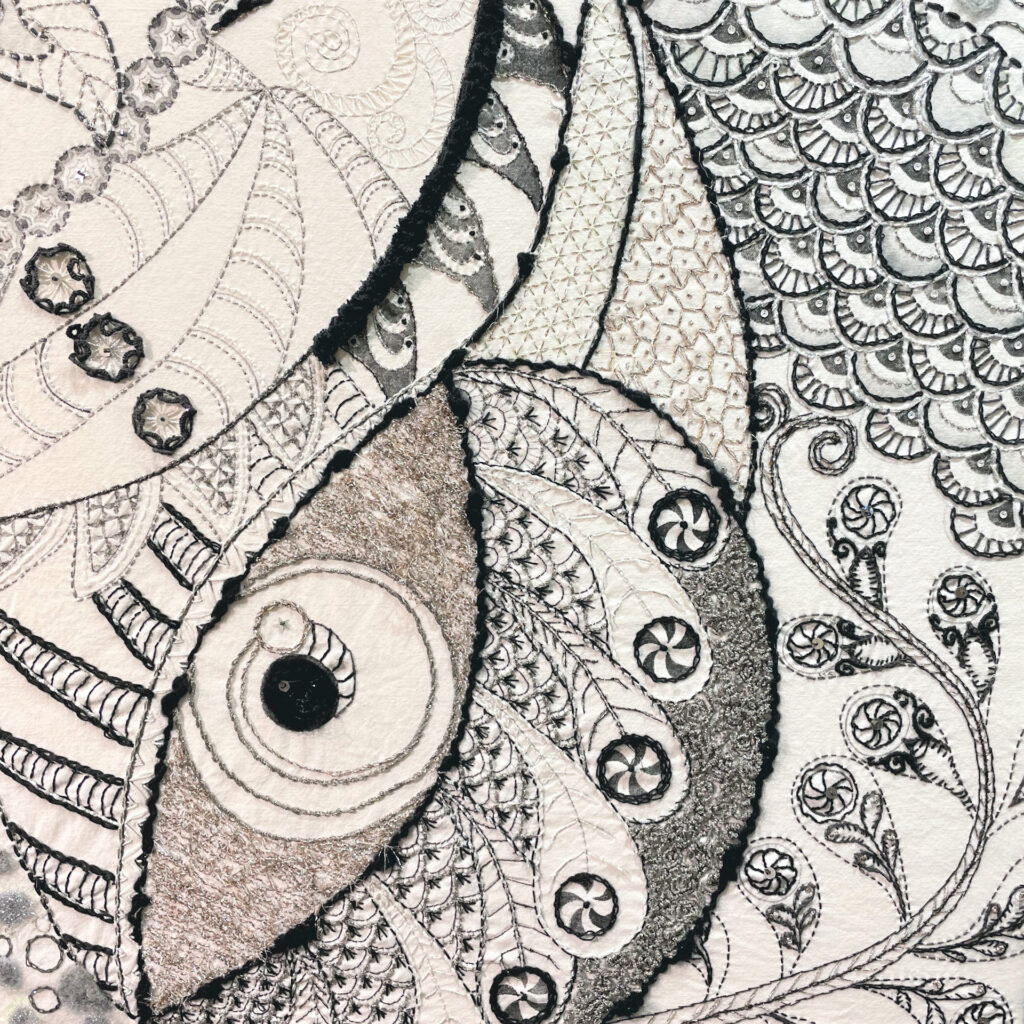
布に針を通し、一本の線を縫い進めていくと、やがて枝のように広がり、模様が徐々にかたちを帯びていきます。墨で線を描くときも同じです。滲みや流れが重なり合うことで、予期しなかったかたちが立ち上がることがあります。
そのプロセスは、木が育ち、水が流れ、雪が結晶する自然の現象とどこか響き合っています。
自然は特別な設計図を前提とするのではなく、比較的単純な法則の反復から、複雑な造形を生み出しています。刺繍や墨の表現もまた、針や筆というシンプルな道具を通して、かたちのリズムを積み重ねていく行為です。
一針ごとに、あるいは一筆ごとに。
自然の中に見いだせるパターンを確かめるように、制作は進んでいきます。
自然の秩序と“生の実感”
この秩序は、決して固定されたものではありません。
フラクタルのかたちは、刻々と姿を変えながらも、全体として一定のパターンを保ち続けます。木々の枝は季節ごとに伸び方を変え、海岸線は波や風によって少しずつ形を変え、雪の結晶も空気の状態によって二つと同じ形は生まれません。それでも、反復のリズムそのものが失われることはありません。
そこにあるのは、「完全な静止」でも「外から与えられた設計」でもなく、環境との相互作用のなかで変化し続ける構造です。条件が変われば形も変わる。しかし、その変化にも一定の法則があります。
森や海辺、雪の舞う風景を前にしたとき、私たちがどこか落ち着きを覚えるのは、この“秩序ある変化”に、安心できる連続性を感じ取るからかもしれません。
フラクタルを見つめることは、自然を観察することにとどまりません。
そこには、変化と安定が同時に成り立つ構造があります。小さな枝の先にも、ひと粒の雪の中にも、全体と共通するパターンが含まれている。
その事実に気づくとき、世界はより一貫した体系として立ち現れてきます。
手でなぞる“自然のリズム”
墨の線を引くときも同じです。
筆先から生まれる一本の線は、呼吸とともにわずかに揺れ、滲みや重なりによって予期しない形を描き出していきます。それは、風に揺れる枝葉や、水面に広がる波紋が、その場の条件に応じて形を変えていく現象にもどこか通じています。
意図だけでは制御できない領域において、
反復や揺らぎのなかから一定のパターンが立ち現れ、画面の中に広がっていきます。針と糸、筆と墨――どちらも私にとっては、自然の構造を手の動きの中で確かめるための手段です。
一見すると単純な作業の積み重ねですが、その繰り返しのなかで、形の秩序が徐々に浮かび上がります。そこには、計算や設計だけでは捉えきれない、素材や条件との相互作用があります。
手を動かす時間は、自然のパターンを身体の感覚を通して理解していく過程でもあります。
完成した模様は、自然に見られる構造と私自身の感覚が重なった結果として、一つの風景のように静かにそこに存在します。
無限を身近にするアート
── 小さなかたちに映る広がり
フラクタルは、「無限」という抽象的な概念を、私たちの感覚に引き寄せてくれる構造です。
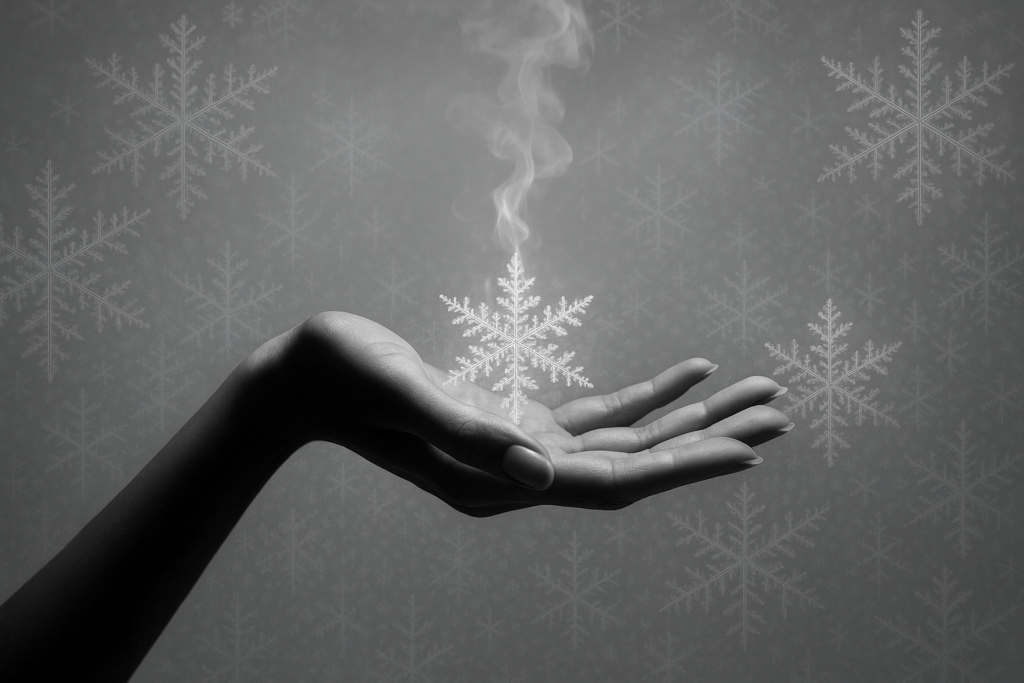
雪の結晶を掌にのせたとき、あるいは木々の枝先をじっと見つめたとき、そこにあるのは単なる小さな形ではありません。限りなく続く反復のパターンが、その一部分として現れています。
フラクタル構造は、拡大しても縮小しても似た形が現れる「自己相似性」を特徴とします。ほんの一部分であっても、全体と共通するリズムが含まれている。小さな水滴に空が映り込むように、部分の中に全体の構造が反映されています。
この構造に目を向けるとき、私たちは自然の外観を観察するだけでなく、秩序という視点から世界を見直すことになります。自然のパターンは、私たちの認識の中で一貫した体系として理解されていきます。
無限は、遠い抽象概念ではありません。
雪片の形にも、木の枝の分岐にも、日常の中に現れています。その事実に気づくとき、世界はより連続的で、統一されたものとして立ち現れてきます。
創造の中で見つけるもの
── 形になる前の領域へ
幾何学模様を縫い重ねる過程は、外へ向かう表現であると同時に、内面の観察でもあります。
制作を続けていると、当初の構想や明確な意図は次第に後景へ退き、代わって、言語化されていなかった感覚や判断の基準が浮かび上がってきます。それは突然のひらめきというより、作業の反復の中から現れる微細な変化です。
重要なのは、思考で形を固定しすぎないことです。
針や筆の運動に注意を向けると、計画だけでは予測できなかった形が立ち現れます。それは感情の表出というよりも、素材や身体の反応との相互作用から生まれる結果です。創造の時間は、自身の内面を整理する時間でもあります。
まだ明確な輪郭を持たない感覚や考えが、制作のプロセスを通して徐々に可視化されていきます。完成した作品は、その過程の痕跡の一部にすぎません。
むしろ重要なのは、制作中に生じる認識の変化や、新たな視点の発見です。創造とは、新しい形を生み出す行為であると同時に、自分の思考や感覚の構造を確認していく行為でもあります。
針を運び、筆を動かす時間は、内面と外界のあいだにある関係性を見つめ直す時間でもあるのです。
次回予告
次回は、自然界にひそむフラクタルの姿をたどります。雪の結晶の六角形、葉脈や樹木の枝に広がる分岐のリズム、そして銀河の壮大な螺旋――。小さな形と大きな形が響き合う世界を、自然と手仕事の関係を、構造という視点からたどっていきます。
自然界のフラクタル構造についての考察は、エッセイページをご覧ください。
幾何学刺繍+墨アートの技法や作品については、こちらのページもご覧ください。
English
Infinite Patterns in Nature
— Tracing the Rhythm of Form with Needle and InkThe branching of trees, the flow of rivers, the curves of coastlines, the crystallization of snow—
Simply by looking down at our feet or up at the sky, we can find countless patterns in nature where similar forms appear again and again.Even when a small portion is isolated, it carries the same rhythm as the whole.
Within the small, the larger form is reflected.
This structure is known as a “fractal.”This rhythm of repetition is deeply connected to my own process of making.
As I pass a needle through cloth and extend a single line of thread, it gradually spreads like a branch, and a pattern begins to take shape. The same occurs when I draw with ink. As seepage and flow overlap, unexpected forms sometimes emerge.
This process resonates with natural phenomena—the way trees grow, water flows, and snow crystallizes.
Nature does not rely on a detailed blueprint. Instead, through the repetition of relatively simple principles, it generates forms of remarkable complexity. Embroidery and ink, too, are practices of accumulating rhythm through simple tools—a needle, a brush.
With each stitch, with each stroke,
the work progresses as if tracing patterns that already exist in nature.
The Order of Nature and the Sense of Life
This order is never rigid or fixed.Fractal forms continuously change their appearance, yet they maintain an underlying pattern as a whole. The branches of trees grow differently from season to season. Coastlines are gradually reshaped by wind and waves. No two snowflakes form in exactly the same way, as each depends on subtle atmospheric conditions. And yet, the rhythm of repetition itself does not disappear.
What we observe is neither perfect stillness nor an externally imposed design, but a structure that evolves through constant interaction with its environment. When conditions shift, forms shift as well. Even so, these changes unfold according to discernible principles.
When we stand before a forest, a shoreline, or falling snow, the sense of calm we sometimes experience may arise from perceiving this “ordered change” — a continuity within variation.
To contemplate fractals is not merely to observe nature.
It is to recognize a structure in which change and stability coexist.At the tip of a small branch, within a single snow crystal, patterns appear that echo the whole.
When we become aware of this, the world emerges as a more coherent and interconnected system.
Tracing Nature’s Rhythm by Hand
The same can be said when drawing a line in ink.A single stroke emerging from the tip of the brush trembles subtly with each breath. As ink seeps and layers overlap, unexpected forms begin to appear. In this process, there is something akin to the way branches sway in the wind or ripples spread across the surface of water—forms shifting in response to their surrounding conditions.
Beyond conscious intention alone, patterns gradually emerge through repetition and variation, expanding across the surface of the work.
Needle and thread, brush and ink—both serve, for me, as means of engaging with natural structures through the movement of the hand.
At first glance, the process may seem simple and repetitive. Yet within that repetition, an order of form slowly becomes visible. What unfolds cannot be reduced entirely to calculation or design; it arises from the interaction between material, gesture, and circumstance.
The time spent moving the hand is also a process of understanding natural patterns through embodied experience.
The completed motif stands quietly as a kind of landscape—formed at the intersection of structures found in nature and my own perceptual awareness.
Making Infinity Tangible Through Art
— Vastness Reflected in Small FormsFractals bring the abstract idea of “infinity” closer to our senses through structure.
When we place a snowflake on the palm of our hand, or closely observe the tip of a tree branch, what we see is not merely a small form. It is a fragment of a repeating pattern that extends without apparent end.
Fractal structures are characterized by “self-similarity”: similar forms appear whether we zoom in or out. Even a small portion contains a rhythm shared by the whole. Like the sky reflected in a drop of water, the larger structure is echoed within the part.
When we attend to this structure, we do more than observe the outward appearance of nature. We begin to understand the world through the lens of order and pattern. Natural forms reveal themselves not as isolated phenomena, but as parts of a coherent system.
Infinity, then, is not a distant abstraction.
It appears in the shape of a snow crystal, in the branching of a tree, within the ordinary moments of daily life.Recognizing this, the world comes into view as something continuous and interconnected—vast, yet quietly present before us.
What Is Discovered in the Act of Creation
— Entering the Realm Before FormThe process of layering geometric patterns through stitching is both an outward act of expression and an inward act of observation.
As the work progresses, the initial concept or clear intention gradually recedes. In its place, unarticulated perceptions and subtle criteria begin to surface. This emergence is not a sudden revelation, but something that arises through repetition and sustained attention.
What becomes important is not to fix the form too rigidly through thought alone.
By focusing on the movement of the needle or brush, forms appear that could not have been fully anticipated by planning. They emerge through the interaction between material, gesture, and circumstance.The time of creation is also a time of clarification.
Impressions and ideas that have not yet taken shape gradually become visible through the process itself.The finished work represents only a trace of this unfolding.
What matters more is the shift in perception that occurs during making—the subtle reorganization of understanding.Creation, then, is not only the act of producing new forms.
It is also the act of examining the structure of one’s own thinking and perception.The movement of the needle and the stroke of the brush become moments in which the relationship between inner awareness and the external world is reconsidered.
Preview of the Next Chapter
In the next installment, we will trace the presence of fractals in the natural world: the hexagonal symmetry of snowflakes, the branching rhythms found in leaves and trees, and the vast spirals of galaxies.Through these examples, we will explore a world in which small forms and large forms resonate with one another, considering the connection between nature and handcraft.
・For reflections on fractal structures found in nature, please visit the essay page.
・To learn more about the technique and works of Geometric Embroidery + Sumi Ink Art, please see the following page.